One planning system for yarn, looms and the process house. It sits on top of SAP and gives every order a date it can keep.
Prepared for
D Decor Home Fabrics Pvt. Ltd.
Prepared by
Lightyear 360 Labs Pvt Ltd
Date
November 2026
01The brief · what PPC360 does
PPC360 plans every order from promise to dispatch.
Marketing enters an order in SAP. PPC360 checks yarn, looms and the process house together and gives a date it can keep. When the floor slips, it simulates options and a planner picks one.
Rule 1
SAP stays the official record.
PPC360 reads SAP and writes back only the plans a planner has published.
Rule 2
Every date comes with its reason.
Each date shows the yarn, loom and machine slots behind it, in plain words.
Rule 3
The planner stays in charge.
PPC360 suggests and simulates. A named planner publishes, and can always override.
01The brief · our reading of the flow
We read D’Decor’s flow as 2 routes and 1 rework loop.
01The brief · why this is hard
1 order touches 8 planning decisions at once.
Today a planner makes each one by hand in Excel. SAP only records what was done.
Small lots across many SKUs mean a change at one stage moves every stage after it. Separate Excel files cannot see that chain.
02Planning · the whole system
PPC360 is built in 5 layers.
Each person sees what their job needs
MarketingA date at order entry
PPC plannersPlans, options and overrides
Work centresTheir own queue, on a screen
LeadershipOTIF and risk, on 1 screen
The engine is normal code, so the same input always gives the same plan. AI is used only to explain, to answer questions and to score risk.
02 · 1Planning · delivery date
Marketing enters an order. PPC360 gives a date it can keep.
02 · 2Planning · yarn
PPC360 works out the yarn and loads each yarn line.
02 · 3Planning · looms and warping
The loom plan is rebuilt to cut gaiting, and dates still hold.
02 · 4Planning · process house
Greige is clubbed into full batches, run light to dark.
03 · 1Control loop · alerts
SAP confirmations come in, and PPC360 flags what slips.
03 · 2Control loop · replan and urgent orders
PPC360 simulates the options. The planner picks one.
03 · 3Control loop · status
Leadership sees on-time delivery and risk live, on 1 screen.
04Data and rollout · data and access
SAP stays the record, and the data stays with D’Decor.
SAP’s standard interfaces (OData services, BAPIs or RFCs), read every few minutes. New and changed orders are picked up on their own.
Write back Dates, sequences, process orders
Through standard SAP interfaces, and only after a planner publishes a plan.
Middleware
D’Decor’s existing middleware if there is one. If not, a small connector service in D’Decor’s cloud.
Test first
Built and tested against a SAP test system before it touches production.
We agree the exact method with D’Decor’s SAP team in discovery.
Data cleansing we expect
Data
What we check
How we fix it
Material BOM
Yarn per metre matches what the floor actually issues
Compare with 3 months of SAP goods issues
Efficiency standards
1 standard per product and loom type
Fill gaps from loom production history
Loom master
Type, width and what each loom can weave
Confirm with the weaving heads
Machine master
Minimum batch and capacity per machine
Confirm with the process house heads
Changeover times
Hours for knotting, gaiting and shade changes
Time them on the floor in discovery if they are not recorded
QA history
Rejection reasons coded the same way
Map free-text reasons to a short code list
04Data and rollout · success measures
We measure success against D’Decor’s own targets.
Each target comes from the brief. PPC360 tracks every one of them from the first week it goes live.
Measure
Target in the brief
How PPC360 tracks it
OTIF delivery
At least 95%, aiming for 100%
Every order against the date confirmed at order entry
Date reliability
Every date from real capacity
Share of orders whose date came from PPC360, not a standard band
Loom efficiency
Fewer changeovers, more knotting, less gaiting
Gaiting and knotting count per month, and loom days lost to them
Process house use
Optimum machine use, with MOQ and clubbing respected
Load per machine and batches run below the machine minimum
Rejection and rework
Early alerts, fewer reprocess loops
Risk alerts raised, and metres reprocessed per month
Visibility
Live status for every stakeholder
Ageing by work centre, live order status and the weekly report
We set the baseline for each measure from D’Decor’s data in discovery, so every gain is measured against today.
04Data and rollout · phases
We build in the order D’Decor suggested.
Discovery and proof of concept
Prove it on real data
1 week on site with the PPC team. Then order promising and the loom plan for 1 loom group, run beside Excel on D’Decor’s own orders.
2 weeks
Weeks 1 to 2 · ends with a demo on real orders
Phase 1
Promise, yarn and looms
Order promising, yarn requirement and the yarn lines, and the full month loom plan across every loom type.
5 weeks
Weeks 3 to 7 · modules 1, 2 and 3
Phase 2
Process house and control loop
Dyeing, printing and finishing plans with clubbing and minimums, alerts at every stage, and replanning with simulation.
4 weeks
Weeks 8 to 11 · modules 4, 6 and 7
Phase 3
Stitching and status
Stitching for bedsheet orders, live status and the weekly report, and quality history that feeds the next order.
2 weeks
Weeks 12 to 13 · modules 5 and 8
Parallel run
Each module runs beside Excel first.
Planners compare both plans for 2 weeks, while the next phase is built, before Excel retires for that module.
SAP
Read-only until sign-off.
Write-back to SAP starts module by module, once the planners sign off.
Timeline
3 months in all.
13 weeks from kickoff to the last module going live. We confirm the plan at the end of discovery.
04Data and rollout · risks and change
5 risks we plan for from day 1.
Risk
What we do about it
Gaps in master data Efficiency standards, BOMs, machine minimums
We check the data in week 1 and list every gap with an owner before any plan goes live.
Planners do not trust the plan
Every date and every move shows its reason. Planners can override with a note, and Excel runs beside PPC360 until they sign off.
Writing to SAP
We start read-only. Write-back uses interfaces agreed with D’Decor’s SAP team and starts only after sign-off.
Shop floor adoption
Each work centre sees only its own queue, on a floor screen or a phone, in the language its team prefers.
Rules we have not seen yet
Rules are settings in the engine, so a new finish, loom type or machine is added without a rebuild.
Change management is part of every phase: training on site for planners, short floor sessions for each work centre, and 1 named owner on each side.
04Data and rollout · open questions
8 things we will confirm in discovery.
The brief leaves these open. Each one changes how the planning engine is set up.
01 · SAP
How plans go back.
SAP version and modules, and whether plans post as planned orders, production orders or a custom table.
02 · Looms
Loom count by type.
Looms by type and width, and which constructions need knotting or gaiting.
03 · Standards
Where efficiencies live.
Are standard efficiencies held per product in SAP, or only in Excel?
04 · Changeovers
How long each takes.
Hours for knotting, gaiting and shade changes on each machine.
05 · Clubbing
How it is decided today.
Who clubs greige, and how far ahead of the delivery date.
06 · Process house
Machines and minimums.
Machine list, MOQ for each, and the finish order rules in use.
07 · Rework
How much, and where.
Share of lots reprocessed today, and how rework is booked in SAP.
08 · OTIF
Today’s baseline.
How OTIF is measured now, with figures for the last 6 to 12 months.
05Investment
Investment, phase by phase.
Discovery and proof of concept
Prove it on real data
Order promising and the loom plan for 1 loom group, on D’Decor’s own orders.
Rs. 8L
60% at kickoff · 40% at the demo
Phase 1
Promise, yarn and looms
Modules 1, 2 and 3, with SAP read and write-back for them.
Rs. 16L
50% at kickoff · 40% ready to test · 10% at go-live
Phase 2
Process house and control loop
Modules 4, 6 and 7: process house, alerts, replanning and simulation.
Rs. 14L
50% at kickoff · 40% ready to test · 10% at go-live
Phase 3
Stitching and status
Modules 5 and 8: stitching, live status, the weekly report and quality feedback.
Rs. 7L
50% at kickoff · 40% ready to test · 10% at go-live
Total build, excluding GST
Rs. 45L
Not included
GST
Cloud hosting and AI model usage
SAP licences and SAP-side work
After Phase 1 goes live · AMC
Rs. 2L to 2.5L a month
Excluding GST. The final figure is agreed before go-live.
A dedicated team
1 product lead
Planning and full-stack engineers
1 AI engineer
What it covers
Updates and fixes
New rules, looms and machines
Newer AI models
Support for planners
05Next steps
Next steps
1
We go through this proposal and the 8 open questions together.
D’Decor and 360 Labs
2
D’Decor shares the discovery pack.
SAP extracts, Excel planning files, loom and machine master, BOM samples, standard efficiencies, sample orders and rejection history.
3
We share our legal and security compliance documents.
360 Labs
4
We start discovery with 1 week on site.
Time with the PPC team and work centre heads, and read access to SAP in a test system.
Co-founder and CEO
Prithvi Raj Agrawal
pra@360labs.ai
Co-founder and CTO
Saurabh Kumar
sk@360labs.ai
Lightyear 360 Labs Pvt Ltd
India’s First AI-Native Software Studio and AI Engineering Lab
360labs.ai
06About 360 Labs · founding team
Founding Team
Prithvi Raj Agrawal
Co-founder and CEOpra@360labs.ai
BSc Mathematics from the University of Toronto, with modules in computer science, psychology, philosophy and advanced economics, followed by BSc IT and Digital Innovation at City University of London, specialising in AI, machine learning and digital product design.
Lead AI Product Manager and Head of Growth at brdge.ai in London, scaling the company past $1.5M ARR in under 6 months alongside the core founding team and delivering AI projects for Barclays, Leonardo, the NHS and the UK Home Office. Core member of the product and growth team at DeepReel.com in London, valued at $10M+, through its $1M pre-seed round, leading enterprise sales and delivery for Accenture and the Aston Martin Aramco F1 Team. Co-founded and raised funding for 2 AI SaaS startups before founding 360 Labs.
Saurabh Kumar
Co-founder and CTOsk@360labs.ai
Hardware engineer and systems programmer with 12 years building government-scale and consumer-scale systems. Built real-time instrumentation for the Indian Meteorological Department and engineered core systems behind IDFC Bank's customer banking application, serving 1.2 million users. Contributed the browser module to BOSS Linux, India's national operating system, deployed across 6M+ government, education and defence devices for C-DAC. Architected SLM360, India's first sub-50MB language model, running on-device at 39ms latency.
Indian patent holder, published author, with Med360 and AgentGuard released publicly. Quantum in Machine Learning and AI Systems, IIT Delhi.
06About 360 Labs · leadership and engineering
Leadership and Engineering
Akshat Bhatia
Regional Partner and Chief Legal Officer
Lawyer and legal technologist. Qualified as Solicitor (England and Wales) from Herbert Smith Freehills Kramer (London), advising UBS, Credit Suisse and Morgan Stanley on roughly $10Bn of transactions and disputes. Founded the firm's Digital Committee, shipping AI tooling into live matters including various $1Bn+ matters. Involved in procurement and pilots on Harvey, Legora, Orbital and other AI vendors. LLB, LLM, MSc AI from various UK universities.
Suryansh Srivastava
Lead Engineer and AI Researcher
Senior Software Associate at Capital One, where he led backend engineering for a platform launched across North America at NADA '26. Received multiple Director awards and Team awards. B.Tech and M.S. by Research in Quantum and AI from IIIT Hyderabad, with a first-authored publication in the Journal of Physics A, a patent in progress, and AWS Certified Solutions Architect.
Rahul Gupta
Chief of Staff and Lead Project Manager
Technical Product & Project Leader building 0→1 SaaS platforms across fintech, CRM, ERP and cybersecurity. Former Sole Product Lead at MortgagX, an AI-native UK mortgage platform engaging Lloyds and Nationwide Building Society. Delivered 200+ production releases with 0 critical defects and 300+ third-party integrations. Led a cybersecurity programme for Belgian firm Sertalink. At Van Technologies, managed UK and European operations and built an early online load-planning system for the removals industry.
Samyak Jain
Senior Full-Stack AI Engineer
Former Senior Engineering Leader with 5+ years at Red Hat, leading Fedora Linux Release Engineering for 1.2M+ users, managing 50,000+ daily packages across 8 releases. Founding member of Konflux, powering OpenShift. Recipient of 2 Red Hat Impact Awards, with 10+ years contributing to Debian and mentoring GSoC & Outreachy. Published IEEE researcher and speaker at FOSDEM, Flock, DevConf, GNOME Foundation and FOSSASIA. CNCF-certified, Product Owner certified by Scrum Alliance, with experience at Nokia and an MBA from NMIMS.
Aditya Malik
Full-Stack AI Engineer
Full-Stack AI Engineer with 5+ years deploying machine-learning systems into production, across real-time systems and full-stack LLM applications. Former Senior Software Engineer at Alegance, where he built AI web applications and production LLM integration pipelines. His experience spans retrieval-backed systems, AWS infrastructure and secure enterprise platforms. Open-source contributor to Neovim (80K+ GitHub stars), Palantir's Blueprint, Hermes Agent, Alacritty, OpenAI, Unsloth, ngrok and Open Jarvis, with a focus on developer tooling and AI agent frameworks.
Nityam Tulani
Full-Stack AI Engineer
Full-Stack AI Engineer specialising in data ingestion, retrieval and multimodal AI: turning raw, inconsistent enterprise data into records that models and planners can trust. Selected for Amazon ML Summer School, Amazon's selective machine-learning programme in India, and for McKinsey.org Forward, its programme for early-career professionals. Placed 2nd nationally at the Samsung PRISM Hackathon, run by Samsung R&D Institute India. Contributes to Gemini open source and Google Summer of Code. His focus is AI that reads documents, images and structured data together.
06About 360 Labs · scale and reach
Scale and reach
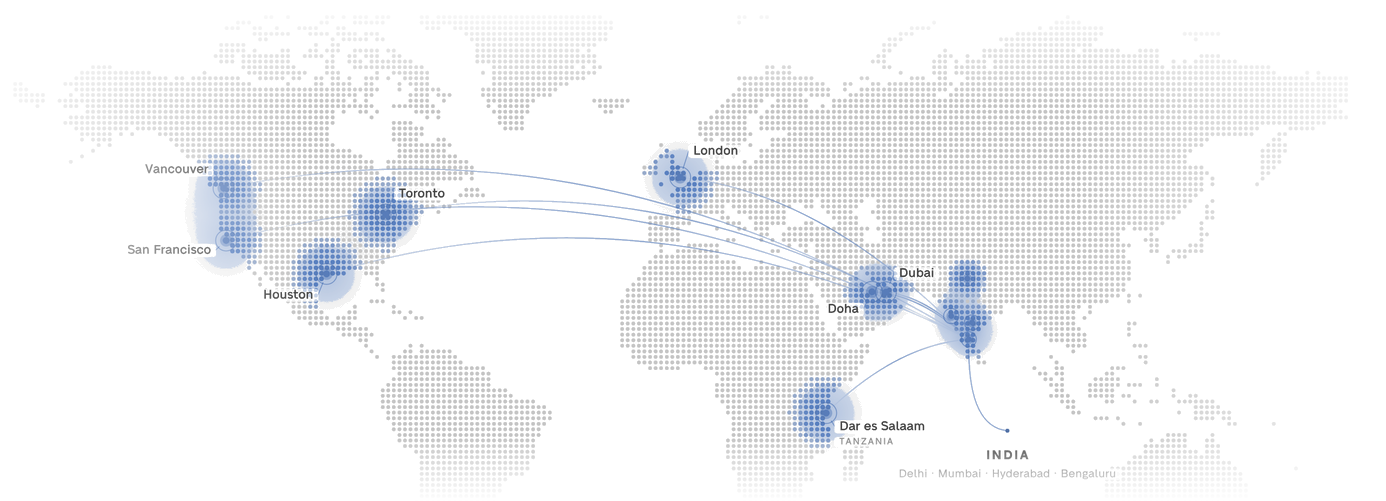
We have engineers on 4 continents. We build for Nifty-500 and Fortune 500 companies, and our logistics platforms are live in India and the USA.
Delivery
50+Customers
30+Deployments
Research & team
100+AI products
10+Papers
20+AI engineers
Global footprint
12+Cities
7+Countries
4+Continents
24/7Coverage
Offices in India
BengaluruManyata Tech Park, Thanisandra, Bengaluru, Karnataka
GurugramTwo Horizon Center, DLF Phase 5, Gurugram, Haryana 122009
HyderabadMindspace, Madhapur Rd, HITEC City, Madhapur, Telangana
MumbaiBandra Kurla Complex, Mumbai, Maharashtra
06About 360 Labs · people and clients
Teams from and affiliated with
Work delivered for
Turn your phone sideways
This presentation is built for a wide screen. Rotate your phone to landscape to view it.
If the screen does not turn, switch on auto-rotate
PPC360 for D’Decor · explainer← → navigate · F full screen · P print01 / 22